zur deutschen Version, Flagge klicken oder tippen

- also called: Viennois, Delphinat, Delphinatus
- historical region in France
- former county
• Flags
• Meaning/Origin of the Flag
• Coat of Arms
• Meaning/Origin of the Coat of Arms
• Map of the historical Regions in France
• Explanations about the Regions
• History
• Origin of the Country's Name
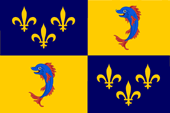
Flag of Dauphiné
– drapeau de la Dauphiné,
Source, by:
Wikipedia (D)


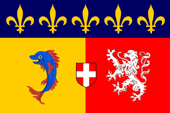
1960–2016,
unofficial flag of Rhône-Alpes Region
– drapeau officieux de la région Rhône-Alpes,
Source, by:
Wikipedia (D)


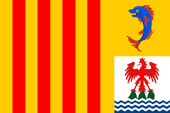
from 1999,
flag of Provence-Alpes-Côte d’Azur Region
– drapeau de la région Provence-Alpes-Côte d’Azur,
Source, by:
Flags of the World

The flag of Dauphiné is a scutcheon-flag, its design is the image of the coat of arms. The with this connected heraldry shows a bunting that is quartered as the coat of arms. The flag shows two times, in field 1 and 3, the blue, with golden lilies topped shield of the Capetians; and the flag shows two times, in field 2 and 4, the heraldry of the Dauphins, a golden field with a dolphin. Since 1999 is in the region of "Provence- Alpes-Côte d’Azur" – to which the Dauphiné partly belongs – an unofficial flag in use, which combines the features of the heraldry of the County of Barcelona (Provence belonged from 1112 to 1245 to the County of Barcelona), of the County of Dauphiné and of the County of Nice. The between 1960 and 2016 existing Region of "Rhône-Alpes", to which the Dauphiné partly belonged, used likewise an unofficial flag, which contained the features of the heraldry of the Dauphiné.
Source:
Volker Preuß,
Wikipedia (D)
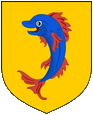
11th century to 1349, d'Albon,
Coat of arms of the County of Vienne under the dynasty of the Dauphins
– Blason du Comte de Vienne sous la Maison des Dauphins,
Source, by:
Heraldique Europeenne
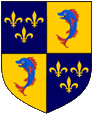
1349–1789,
Coat of arms of Dauphiné
– Blason du Dauphiné,
Source, by:
Wikipedia (DE)
The oldest known coat of arms of Dauphiné showed the heraldry of the Counts of Vienne from the House of Albon (also called d'Albon). In 1107 they became the Counts of Dauphiné, called themselves Dauphins (Dauphin = dolphin), and their coat of arms showed a golden shield with a dolphin. As of the last count of the dynasty of the Dauphins sold the county and the title of the "Dauphin" in 1349 to Charles of Valois, the county came to the French crown. The heraldry of the Dauphiné was combined with the heraldry of the Capetians, that dynastie, from where the House of Valois emerged in 1285 as a branch. The new coat of arms is quartered and shows two times, in field 1 and 3, the blue, with golden lilies topped shield of the Capetians; and two times, in field 2 and 4, the heraldry of the Dauphins, a golden field with a dolphin. The coat of arms of the Capetians showed three golden lilies on blue, but originally was the coat of arms sprinkled with lilies. From 1365 (by others sources 1376), the number of lilies was reduced to three. The lily-symbol is very old, already the Germanic tribe of the Franks has used it. The House of the Capetians has provided the kings of France between 987 and 1328. It goes back to Hugo Capet, son of Hugo the Great, who was electet to the King of France, in 987, after the death of King Ludwig V. from the House of the Carolingians. The Capetians brought out three branch lines which became the Kings of France: Valois 1328–1589, Bourbon 1589–1792 and 1814–1830, and Orléans 1830–1848.
Source:
Wikipedia (D),
Heraldique Europeenne,
Volker Preuß
The historical, French Regions:

in black: governorate and province in 1776,
in red: former county, province oder governorate
Map: Volker Preuß
The provinces (or governorates) that existed until the French Revolution were historically grown entities that had often developed from former fiefdoms of the French crown, historical counties and duchies, often existed for hundreds of years and had preserved regional characteristics (cultural peculiarities and regional languages). Such phenomena were naturally undesirable to the French Revolution, and in the context of its bloody and violent egalitarianism, all regional references were eradicated. Shortly after the Revolution, the provinces were dissolved and France was divided into many small départements, which were to be approximately the same size and have the same status, controlled by prefects of the central administration in Paris. The departments were named after rivers or mountains so as not to use the names of any of the old provinces. However, it was not possible to sever the ties between the inhabitants of France and their respective historically grown regions, so that in 1960 regions were created again. There can hardly be said to be any real autonomy. The regions are only supposed to promote the economic, social, health, cultural and scientific development of the region, keep an eye on housing and living conditions, and provide support in some areas, e.g. urban development policy, urban regeneration, regional planning, preservation of regional identity and promotion of regional languages. When the regions were formed, departments located in a particular historical province were administratively grouped together into a region that often had the same historical name. The resulting entities only roughly corresponded to the boundaries of historical provinces. In strictly centralised France, however, any form of responsible regionalism is avoided. The regions do not even have their own seals with which to mark their own legally binding decisions, because there are no plans to introduce such a thing. Therefore, anything to do with coats of arms or flags is completely irrelevant. The logos of the regions are used generally, sometimes with the colours reversed and placed arbitrarily on flags or banners. There are no rules, as they are not official symbols. The logos and flags of the regions therefore often look like company logos: Unloving, unhistorical, technocratic and modernistic. That is why most of these regions have a kind of unofficial heraldic flag, which is intended to recall historical heraldic models. However, these are merely decorative in nature and are not a symbol of sovereign functions. The regions created in 1960 were even called into question in 2014, and a territorial reform was decided – centrally from Paris – which reduced the number of regions by almost half through mergers. The regions and their institutions were not even consulted on this matter.
Wikipedia Link to the regions of France:
click or tap here
FOTW Link to the regions of France:
click or tap here
Source: Flags of the World,
Wikipedia (D),
Volker Preuß
antiquity · settlement by Celtic tribes, the largest of them are the Allobroges
58 B.C. · Roman conquest, the area comes to the provinces of Gallia Narbonensis and one of the three Alpine provinces
52 B.C. · an uprising of the Gauls under Vercingetorix is suppressed
4th/5th century A.D. · the Burgundians come from the region between the Oder River and Vistula River and invade into the Roman Empire, settle on the Middle Rhine near Worms and plunder neighboring Roman settlement areas
436 · the Kingdom of Burgundy in the Middle Rhine area is shattered by Huns in Roman service
443 · the surviving Burgundians get settled by the Romans in the area of Lake Geneva and the today's Savoy
443–500 · establishing of the Kingdom of Burgundy (Burgundia), territorial expansions
534 · conquest of the Kingdom of Burgundy by the Franks, today's Burgundy comes to the Frankish Empire, the area will remain as part of empire with its own administration
870 · at the division of the Frankish Empire (Treaty of Meersen) arises the West Frankish Kingdom, the East Frankish Kingdom, and the Frankish Kingdom of Italy – Burgundy gets divided, the north (Upper Burgundy) comes to the West Frankish Kingdom, the south (Lower Burgundy) comes to the Frankish Kingdom of Italy
877 · Lower Burgundy separates from Italy
879 · Boso of Vienne is king of Lower Burgundy
880 · by the division of the Frankish Empire (Treaties of Verdun and Ribbemont) arises the West Frankish Kingdom (later France), the East Frankish Kingdom (later German Empire), the Kingdom of Italy, the Kingdom of Upper Burgundy (under Rudolf the Welf), the Kingdom of Lower Burgundy persists, and formerly Burgundian territories in the northwest come as "Regnum Burgundiae" to the West Frankish Kingdom too
920–1016 · Regnum Burgundiae develops to a duchy of France, which adopts the name of Burgundy (=> Duchy of Burgundy)
951 · Upper Burgundy and Lower Burgundy become united to the Kingdom of Burgundy, under Conrad III. of Upper Burgundy, this country is also called Arelat
1033 · the Kingdom of Burgundy (Arelat) comes as an inheritance to the German Empire, the Roman-German Emperor Conrad the Elder is elected in Peterlingen (Payerne) to the king of Burgundy, but in subsequent years, the country is divided into several counties (County of Provence, County of Venaissin, County of Savoy, County of Dauphiné, Franche-Comté), the last king of Burgundy is the Emperor Charles IV., who was enthroned in 1365
1063 · beginning of the reign of the Counts of Albon (also called County of Vienne) in the today's Dauphiné, but the dynasty extincts at the end of the 12th century with Count Guigo VI ., the doughter and heiress Beatrix marries as second husband Duke Hugh of Burgundy, with their son Guigo VII. the second dynasty of the Counts of Albon is founded – the name Dauphin (Dolphin) continues as a title for the counts
1281 · with John, the third Dauphin from the Burgundian house, the second dynasty of the Counts of Albon extincts in 1281 again, the legacy goes to his sister Anna, who gets married with Humbert I. Count of Latour du Pin, with their son John II. is founded the third dynasty of the Dauphins, he is later succeeded by his brother Humbert II.
1335 · Humbert II. makes peace with Savoy and consolidates the country, in the same year dies his only son and successor by a fall from the window
1349 · Humbert II. sells the County of Dauphiné to Charles of Valois (as Charles V. King of France 1364-1380), but just on the following conditions: the French heir of the throne has always to use the title "Dauphin", as well as the respective coat of arms, for the Dauphiné it must be allowed to retain a certain autonomy and freedoms, and France has the country never to affiliate fully
1355 · death of Humbert II., the region of Faucigny gets separated from the Dauphiné and connected to Savoy, which belongs to the German Empire, however, the Dauphiné gets incorporated in France
14th to 18th century · the County of Dauphiné is awarded again and again as an appanage to the firstborn son and successor of the throne of the kingdom of France, but the country is equipped with some special rights of a estates state, what could be an own estates assembly (a kind of parliament) or may even mean an own tax jurisdiction towards the king, the last French Crown Prince who was officially named Dauphin was Louis-Antoine de Bourbon (1775-1844), Duke of Angoulême (Louis XIX.), son of Charles X. (1830 abdication)
1713 · Treaty of Utrecht, Dauphiné has to cede again territories in the east to Savoy
1763 · uprising against the King to safeguard the privileges
1776 · the already in the 14th century created governorates of the civil administration of the kingdom of France become committed to a number of 39, and correspond in this way to the number of provinces, in previous years could any provinces be summarized in one governorate
1788 · uprising against the King to safeguard the privileges
1798 · on the occasion of the French Revolution the estates-state of Dauphiné and the respective privileges become mosty abolished and the entire region was divided into departments (Isère, Drôme and Hautes Alpes)
1791 · dissolution of the assembly (parliament)
1960 · reintroduction of regions in France, the Dauphiné doesn't play a role, the departments of Isère and Drôme come to the Rhône-Alpes Region, the department of Hautes Alpes comes to the Region of Provence-Alpes- Côte d' Azur
2016 · the Rhône-Alpes region merges with the Auvergne region in the new, larger region of Auvergne-Rhône-Alpes
Source:
Meyers Konversationslexikon,
Wikipedia (D)
The dynasty of the Counts of Albon acquired the county of Vienne in 1063. Derived from the name of this town, the county was also called ‘Viennois’. In the 12th century, the coat of arms of Count Guigues IV of Albon featured a dolphin on a golden shield, earning him the nickname le Dauphin ("the Dolphin"). His successors adopted this nickname as a dynastic title and henceforth called themselves "Dauphin de Viennois". The territory was accordingly named "Dauphiné". When the last count of the Dauphin dynasty, Humbert II, sold the county and the title "Dauphin" to Prince Charles of Valois (King Charles V of France from 1364 to 1380) in 1349, the county passed to the French crown. But that was not all. One condition of the contract was that the title "Dauphin" should henceforth belong to the heir to the French throne. Since then, the French crown princes have borne this title. The last crown prince, who officially beared the title "le Dauphin" was the son of King Charles X, Louis-Antoine de Bourbon. Charles X abdicated after the July Revolution of 1830 and renounced the throne. To this day, however, the eldest son of the House of Bourbon (pretender to the throne) is still referred to as "Dauphin".
Source: Volker Preuß, Wikipedia (EN), en.geneanet.org