This page is part of the project
www.flag-encyclopedia.com


zur deutschen Version, Flagge klicken oder tippen


Flags on ships


A merchant ship under full flag, displaying the most common signal flags

Flag-flying on a merchant ship

The image illustrates where different flags may be flown on a merchant ship. The merchant ship shown above is currently flying the 'Blue Peter' as a signal flag. This is flag P (Peter) of the international flag alphabet; it is hoisted when the ship is due to set sail within 24 hours. No courtesy flag has been hoisted here.
Example: passenger ship


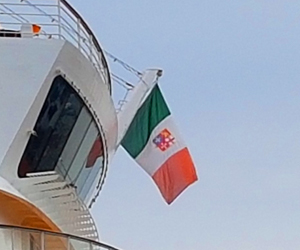
The AIDA-Luna is owned by an Italian owner and is registered in Genoa. Consequently, the Italian merchant flag flies at the stern. Pictured here: the passenger ship AIDA-Luna in the port of Stavanger, Norway, on 23 August 2018


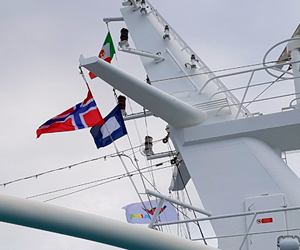
The foremast displays the stern flag in the centre, with the AIDA Cruises company flag (shipping company flag) on the port side (left) and, on the starboard side (right), signal flag P (ship about to set sail) and the courtesy flag (Norway). Pictured here: the passenger ship AIDA Luna in the port of Stavanger, Norway, on 23 August 2018


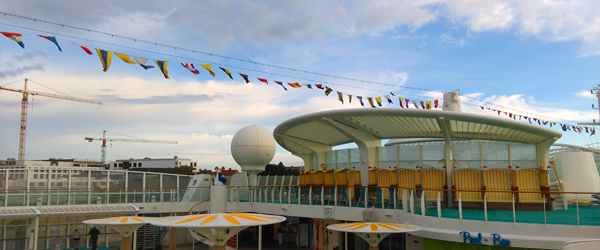
Set of signal flags – pictured here: the passenger ship AIDA Luna in the port of Kiel on 25 August 2018


Explanations of the individual flags:

Merchant flag

A merchant flag is a flag flown by a state’s merchant ships, which often resembles the state or national flag. The right to fly the merchant flag is granted by the flag certificate issued by the state in which the ship is registered, and it must be flown by every merchant ship entered in the ship register. Consequently, the merchant flag may only be flown by vessels that are not warships, government or auxiliary vessels, or yachts. The key distinction here is that a vessel does not constitute an extraterritorial area; it belongs to a private individual or similar entity as a merchant vessel and does not represent the state itself. Thus, the use of the national or, indeed, state flag is normally precluded. The merchant flag was created precisely to give these private individuals the opportunity to declare their nationality. Declaring one’s nationality is particularly necessary when entering and leaving a port. In the English-speaking world, the merchant flag is referred to as the 'Civil Ensign' or 'Merchant Ensign'.

hoch/up

Jack or home port

The Jack is actually the bow flag flown by warships. In some countries, however, the Jack is also commonly flown by merchant ships. Furthermore, it may be identical to the merchant flag, or there may be a flag specially designed for this purpose. The Jack is hoisted when the ship is anchored or moored in port. If the Jack is not mandatory, the flag of the home port is generally hoisted instead. This allows one to identify the city from which the ship comes.

hoch/up

Courtesy flag

The courtesy flag is hoisted by ships and boats when they enter the waters, and in particular the ports, of another country and drop anchor. It is flown on the starboard mast, higher than – or at least at the same height as – the vessel’s own national flag. This is intended to signify that the vessel is subject to the laws of the country being visited. Strictly speaking, a flag is not actually required for this, as every vessel, whether a cargo ship or a sailing vessel, is always subject to the jurisdiction of the country within whose territory it is currently located, since a vessel is not an extraterritorial area. Merchant ships fly the merchant flag of the respective host country as their courtesy flag, whilst all private ships, boats and yachts not registered as merchant ships use the national flag of the respective country of destination for this purpose. An exception to this rule is usually the merchant flags of the countries of the Commonwealth of Nations, specifically those which use a Red Ensign as their merchant flag. A Red Ensign may also be flown at sea by private individuals, and consequently may be used as a courtesy flag, although this is not compulsory. However, some countries of the Commonwealth of Nations have restricted the use of the Red Ensign to their own merchant vessels, meaning that no foreign merchant vessel is permitted to fly the Red Ensign as a courtesy flag. Violations are penalised upon entry into the foreign port (e.g. India, Pakistan). In case of doubt, private individuals should therefore always fly the respective national flag as courtesy flag. It was once customary for both flags – that is, the own national or merchant flag and the courtesy flag – to be struck at sunset and hoisted again in the morning. However, this custom has not been maintained. Thanks to Captain Peter and Captain Snoo.

hoch/up

Customs flag

The customs flag is a flag that indicates whether – and sometimes where – the ship was last cleared through customs. It is therefore not the flag of the customs authority itself.

hoch/up
 

Shipping company flag

Shipping companies are firms that carry out the transport of passengers and goods by sea for commercial purposes. These firms also have their own flags and the right to fly them at sea.

hoch/up
 

Distinctive signal

The distinguishing signal consists of four signal flags from the international signal flag alphabet, which correspond to the radiotelegraphic call sign – that is, a combination of numbers and letters.

hoch/up
 

Flag of the country of destination

The flag of the country of destination indicates in which country the ship’s port of destination is located.

hoch/up

Postal flag

The post flag is a special flag. It indicates whether there is post on board. In the days when postal services were part of a country’s sovereign responsibilities, the post flag was often an emblem similar to the national flag. Most postal systems worldwide have now been privatised, meaning that it is no longer a sovereign function but a commercial enterprise that is no longer indicated by a special flag. Furthermore, the most common method of postal delivery today is air freight. For the reasons mentioned above, one is now rarely likely to encounter the post flag on the high seas.

hoch/up
 

Signal flags

International signal flags are used to display or exchange information. Their use is governed by strict, internationally standardised rules and regulations. A set of these signal flags is called a ‘set’. A set consists of 26 letter flags, 10 number pennants, 4 auxiliary flags and 1 reply pennant. The flags are usually displayed one below the other in sequence and read from top to bottom.

hoch/up
 

Regulations for yachts and boats

Of course, there are also regulations governing how yachts and boats should be flagged or illuminated, including internationally binding provisions. However, when it comes to flagging in particular, this is regulated independently by the respective states; for example, some states require a specific yacht flag, or a specific bow pennant for the bow of the boat or yacht (Jack), or at the very least a national flag at the stern. The specific procedures to be followed in each case are laid down in legislation; in Germany, this is the "Act on the Flagging of Seagoing Vessels and the Flying of Flags by Inland Waterway Vessels (Flag Act)".

hoch/up


Click here to go to the start page