zur deutschen Version, Flagge klicken oder tippen

Along with the leopard and the lion, the eagle is one of the animals most frequently found on coats of arms. Even in ancient times, the eagle symbolised immortality and earthly power. The eagle’s characteristics, such as vigilance and a fighting spirit, were intended to be bestowed upon the bearer of the coat of arms.
It is very, very often depicted taking flight, viewed from the front, ready to attack, with its head turned to one side, its talons spread and its wings half-outstretched.
The feathers above the body are depicted as pointed scales with a keel. On the wings, a few feathers are spread out evenly and symmetrically, increasing in length towards the body, and forming a semicircle with their tips. Between them, fine, pointed feathers (filaments) are often visible.
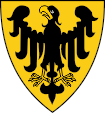
Eagle, up until the 14th century,
picture, following:
Gert Oswald
Lexikon der Heraldik
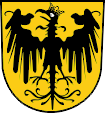
Eagle, from the 15th century onwards,
In the early days of heraldry, two threads were depicted on either side of the eagle’s neck; in more recent times, a row of spread feathers has been used. The eagle’s tail is often depicted in a stylised manner, with one feather pointing downwards and a few others curving symmetrically to the sides.
The eagle’s head is always turned to one side; in the early days of heraldry, it looked upwards. Its gaze is fierce and fiery; its beak is strongly curved downwards, usually open, with its tongue protruding.
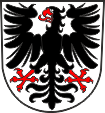
Eagle, from the 15th century onwards,
picture, following:
Gert Oswald
Lexikon der Heraldik
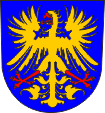
Eagle, from the 16th century onwards,
picture, following:
Gert Oswald
Lexikon der Heraldik
The eagle’s feet are always depicted as disproportionately large, without feathers, with one hind toe and three front toes, with the talons curving sharply outwards from the toes. This disproportionate size is due to the need to fill the space on the shield as decoratively and harmoniously as possible, whilst avoiding empty areas.
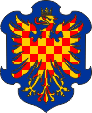
Chequered eagle, Moravia
The eagle can appear in any colour or metal (even chequered), although black, red and silver are the most common. The talons are usually depicted in a different colour. In heraldry, this is referred to as 'tinted' (meaning painted in a contrasting colour over the entire surface). However, gold is most commonly used, even on a gold field, and red is also frequently encountered.
Heraldry recognises only six colours:
red, blue, green and black (as colours), and gold and silver (as metals):
(Click on the colours to see explanations of each one)


Later on, a number of other colours were added, such as
purple, brown and orange, as well as more unusual shades like iron grey, ash grey and flesh tones.


Across the body – from wing to wing – there is sometimes a crescent coloured to look like metal, pointing upwards, the ends of which sometimes take the form of a clover leaf (clover stem). This custom may have originated from metal brackets used to attach eagle sculptures to poles or shields, or it may have stemmed from brackets used to reinforce shields, which were subsequently incorporated into the coat of arms.
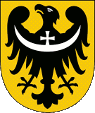
Eagle, with a metal sickle, Silesia
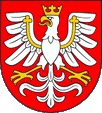
Eagle, with clover stalks, Lesser Poland
One distinctive feature is 'stubbed' motifs – that is, depictions consisting solely of eagle heads, feet or wings. A pair of wings is in German heraldry called a 'flight', whilst a single wing is known as a 'half-flight'.

Non-heraldic eagle,
Prussia, official flag
Depictions of eagles in flight, in a natural pose or in the Roman style are considered non-heraldic and are therefore not described separately in heraldry.
The number of heads on the eagle
The number of heads on the eagle plays an important role in German and Russian heraldry. The German eagle has its origins in the eagles of the Roman legions and ultimately symbolises the empire, embodying stability, justice and power.
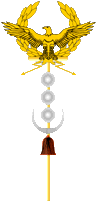
Roman legionary eagle
In 395, the Roman Empire was divided into an Eastern Empire and a Western Empire. The Western Empire came to an end in 476 with the deposition of the last Roman emperor, Romulus Augustulus, whilst the Eastern Empire gave rise to the Byzantine Empire.
The Holy Roman Empire of the German Nation, founded in the year 800, regarded itself as the successor to the Western Roman Empire and, consequently, adopted the eagle as its symbol, just as the Byzantine Empire had done. The eagle of the Byzantine Empire, however, was depicted with two heads, one representing Rome and the other Constantinople.
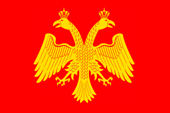
Byzantine Empire
Holy Roman Empire of the German Nation
Under pressure from the Turks, the Byzantine Empire began to gradually disintegrate at the start of the 15th century; Constantinople fell in 1453 and the last remaining territory of Trebizond in 1461. In this situation, the Holy Roman Empire of the German Nation saw itself as the last guardian of Roman power and, from 1433 onwards, adopted the double-headed eagle to signify its assumption of the historical legacy of the Eastern Roman Empire as well.
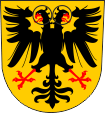
Holy Roman Empire of the German Nation, from 1433
The Russian Empire, which, through the Orthodox Church, regarded itself as the heir and successor to the Byzantine Empire, also adopted the latter’s symbolism of the double-headed eagle. After the Holy Roman Empire of the German Nation was dissolved by Napoleon in 1806, Austria, as the ruling dynasty of the former Habsburg emperors of the Empire, retained the coat of arms featuring the double-headed eagle, as did the German Confederation (1815–1866), the confederation of German states that succeeded the Holy Roman Empire of the German Nation.
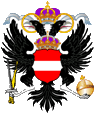
Empire of Austria

German Confederation
Following the dissolution of the German Confederation (1866), the Russian double-headed eagle – in order to uphold the continuation of its political and religious mission as the successor to the Roman Empire – was not given a third head, but was instead given a third crown. This is a clear indication of Russia’s self-proclaimed claim to be the 'Third Rome'.
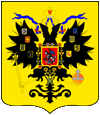
Empire of Russia, until 1917
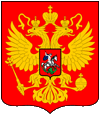
Russian Federation, from 1993
Sources: Volker Preuß,
Katechismus der Heraldik,
Lexikon der Heraldik