zur deutschen Version, Flagge klicken oder tippen

Along with the leopard and the eagle, the lion is one of the animals frequently found on coats of arms, which usually represent towns, companies or families.
Since as far back as the 13th century, every citizen has been entitled to bear a coat of arms. Today, around 90 per cent of all recognised and traceable family coats of arms belong to members of the general public. There are two ways in which a coat of arms can be legally adopted. Firstly, an existing, historical family coat of arms can be adopted. In this case, genealogical origin must be proven, i.e. that there is a family relationship to the original founder of the coat of arms. Secondly, it is possible to create one’s own coat of arms. This refers to the design and registration of a new coat of arms. Heraldry is subject to strict rules dating back to the 12th century which are still in force today. Anyone wishing to have a family coat of arms created must ensure that all the rules of heraldry are observed. Only then can the designed coat of arms subsequently be registered and officially recognised.
From the very beginning, the lion was chosen as the symbol for one reason alone: everyone should be able to understand immediately what was depicted on the coat of arms. In the Middle Ages, many people could not read, which is why people at that time chose images of animals, amongst other things, in the belief that the characteristics associated with a lion – such as courage or strength – would be transferred to the bearer of the coat of arms.
It may appear individually or as a group. A distinctive feature is a truncated appearance, i.e. parts of the body, such as the head, feet or claws, may be depicted as torn off or cut off. A head viewed from the front is called a 'face', whilst the upper part of the head is called the 'forehead'. The animals are often crowned, sometimes wearing a collar, a muzzle or a bell (a bell around the neck). The teeth, claws and beak are referred to as 'weapons'. The animals may appear in any colour, but most commonly in the heraldic colour (tincture) that most closely resembles their natural colour. This means red or gold for the lion, black or red for the eagle, and silver for the elephant.
Heraldry recognises only six colours:
red, blue, green and black (as colours), and gold and silver (as metals):
(Click on the colours to see explanations of each one)


Later on, a number of other colours were added, such as
purple, brown and orange, as well as more unusual shades like iron grey, ash grey and flesh tones.


There are various ways of depicting a lion. The two most common postures are: 1.) rampant or upright (standing on its hind legs, one hind paw forward, the front paws raised at different heights), 2.) striding or walking, lion passant, (with one front paw raised). The rearing depiction is regarded as the basic form and does not need to be specifically stated (blazoned) when describing a coat of arms. The lion is depicted from the side, i.e. in profile, usually facing heraldic right (to the left when viewed from above). For birds, the most common posture is in flight (with wings fully or half-spread), followed by perched.
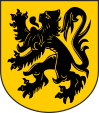
lion rampant
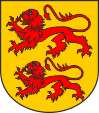
lion passant
Over the years, the depiction of lions on coats of arms has become increasingly realistic; whereas they used to be rather angular, they are now more rounded and natural in appearance. The mouth appears open, usually with the tongue protruding far out, depicted as a curved line that curves upwards at the front. The teeth are visible (the lion is ‘armed’ with teeth) and the lion’s gaze is fierce. The lion’s body is always depicted as very slender; the rear third, in particular, often appears very lean.
Before and during the 14th century, the rampant lion was depicted in a relatively straight manner, aligned with the longitudinal axis of a narrow shield. With the emergence of wider shields – from the 15th century onwards – the shape of the body was depicted in a more curved and dynamic manner, sometimes verging on a serpentine line. The space on the shield had to be filled as decoratively and harmoniously as possible, whilst avoiding empty areas. In the early days of heraldry, the lion was depicted with an evenly shaggy coat across the shield; later, only the mane was emphasised, which could cover half the body and was rendered in a luxuriant style. Apart from the mane, only the paws are depicted as shaggy.
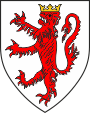
Lion, up to the 14th century,
picture, following: Eduard Freiherr von Sacken "Katechismus der Heraldik"
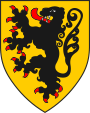
Lion, up to the 15th century,
picture, following: Eduard Freiherr von Sacken "Katechismus der Heraldik"
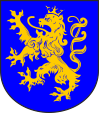
Lion, up to the 17th century,
picture, following: Eduard Freiherr von Sacken "Katechismus der Heraldik"
Lion, up to the 18th century
In early heraldry, the lion’s paws were depicted with three pads in the shape of a shamrock, and a fourth pad below them, from which the claws (weapons) emerge. In later heraldry, the four pads with the claws are depicted more separately and appear widely spread apart.
The lion’s tail curves upwards close to the base and runs parallel to the body. In the early days of heraldry, the tail was depicted as very shaggy; later, from the 14th century onwards, it was depicted with only a few tufts pointing outwards, and the tip (the hairy end of the tail) curves inwards, towards the lion’s body. From the 15th century onwards, the tail was frequently depicted as forked, as a double or triple tail, each with its own tuft, and the tails are twisted like a rope. However, this is purely decorative; the number of tails has no heraldic significance and need not be specifically stated. Nevertheless, certain variations have become established. One need only think of the Hessian Lion and, above all, the Bohemian Lion, where the double tail has survived to this day and is still depicted as double-tailed in the coat of arms of the Czech Republic. The tuft at the tip of the tail may be a different colour, described as 'tufted'.
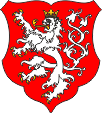
Bohemian Lion
The heraldic colours of the lion are, first and foremost, those that most closely resemble its natural colour – that is, red or gold, which are very common. Black or blue are less frequently encountered. The claws are usually depicted in a different colour. In heraldry, this is referred to as ‘tinted’ (meaning painted in a contrasting colour over the entire surface). If the lion is depicted in metal (silver, gold), the claws appear in colour (e.g. red or blue). If the lion is depicted in colour, the claws appear in metal. As a general rule, the colours of the claws must contrast with the field colour. Teeth and eyes are usually depicted in silver. If the field colour is silver, the teeth and eyes must be depicted in colour.
If the animals are wearing a crown, a simple ring-shaped crown with three leaves is used: one whole leaf in the centre, and half a leaf on either side. Closed or hoop-shaped crowns must not be used. The crown should sit vertically on the head. It is sometimes worn at an angle, but this is not actually desirable.
Distinguishing between a lion and a leopard is simple, though not necessarily obvious. It is not a question of body shape or whether or not the animal has a mane, but simply whether the animal is looking at the viewer of the coat of arms or not. The animal is depicted striding, standing on three legs, with the front paw raised, the inner hind paw slightly forward, and the tail curled back over the back. If the animal is looking at the viewer (facing forwards), it is a leopard; if its gaze is directed sideways, it is a lion. This has led to some confusing designations: A) a rearing, forward-facing lion is called a lion guardant (lion-like leopard); B) a striding, sideways-facing lion is called a lion passant (leopard-like lion). Naturally, the slender build of the striding animal – which becomes increasingly slender the more of it that has to fit onto the coat of arms – tempts one to describe it as a leopard, regardless of whether the animal is looking straight ahead or not. Consequently, A) is sometimes also called a 'leopard-like lion', and B) a 'lion-like leopard'.
lion passant (leopard-like lion)
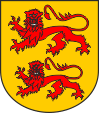
lion passant guardant, leopard
lion rampant
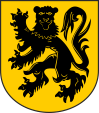
lion guardant (lion-like leopard)
How did this peculiar classification come about? Right up until late antiquity, there were lions in Bulgaria and north-eastern Greece, in North Africa and Mesopotamia (modern-day Iraq); leopards in North Africa and Cyprus; and even tigers in Anatolia. The Romans were not particularly keen on observing nature, so the differences between the various species were not widely known. Consequently, the Latin name for all these big cats was 'Panthera', meaning 'panther'. In heraldry, the panther is also recognised as a common figure. It is depicted as a fire-breathing, rather slender, sometimes winged mythical creature, and thus has no heraldic connection whatsoever with the lion or the leopard. In any case, early heraldry made no distinction between lions and leopards. Everything was a lion. With the extinction of these big cats in Europe, North Africa and the Near East, the differences faded from memory anyway and became the stuff of legend.
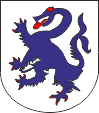
Panther (Pantier)
However, the cause of their extinction was not the Roman circus games, which, incidentally, were strictly banned by Emperor Nero. Their disappearance from the areas mentioned has a much simpler reason: population growth. The more people there are, the more land is used for agriculture, and the less steppe, pasture, grassland and woodland there is in which the prey of big cats lives – just as is the case with the prey of wolves, lynx and bears. In zoology, big cats form a subfamily of the cat family (Felidae) and are still referred to today as 'Pantherinae'. The genus to which the 'true big cats' belong is still known today as 'Panthera'. This includes, amongst others, the lion 'Panthera leo', the leopard 'Panthera pardus' and the tiger 'Panthera tigris'.
Sources: Jürgen Kaltschmitt, Volker Preuß, Wikipedia, Wikipedia, Katechismus der Heraldik