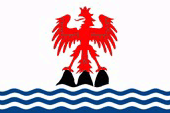
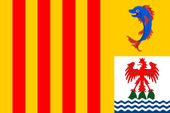
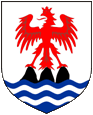
The flag of the County of Nice is a scutcheon-flag, it shows the image of the coat of the city. Since 1999 is in the region of "Provence- Alpes-Côte d’Azur" – to which Nice belongs – an unofficial flag in use, which combines the features of the heraldry of the County of Barcelona (Provence belonged from 1112 to 1245 to the County of Barcelona), of the County of Dauphiné and of the County of Nice.
The coat of arms of Nice shows a silvery shield, on it a red eagle with red clover stems and a red crown. It stands on a black three-mountain, which rises from blue waves. There exist also representations in which the eagle is golden armed and wears a golden crown, and the three-mountain is sporadically displayed in green.
The provinces (or governorates) that existed until the French Revolution were historically grown entities that had often developed from former fiefdoms of the French crown, historical counties and duchies, often existed for hundreds of years and had preserved regional characteristics (cultural peculiarities and regional languages). Such phenomena were naturally undesirable to the French Revolution, and in the context of its bloody and violent egalitarianism, all regional references were eradicated. Shortly after the Revolution, the provinces were dissolved and France was divided into many small départements, which were to be approximately the same size and have the same status, controlled by prefects of the central administration in Paris. The departments were named after rivers or mountains so as not to use the names of any of the old provinces. However, it was not possible to sever the ties between the inhabitants of France and their respective historically grown regions, so that in 1960 regions were created again. There can hardly be said to be any real autonomy. The regions are only supposed to promote the economic, social, health, cultural and scientific development of the region, keep an eye on housing and living conditions, and provide support in some areas, e.g. urban development policy, urban regeneration, regional planning, preservation of regional identity and promotion of regional languages. When the regions were formed, departments located in a particular historical province were administratively grouped together into a region that often had the same historical name. The resulting entities only roughly corresponded to the boundaries of historical provinces. In strictly centralised France, however, any form of responsible regionalism is avoided. The regions do not even have their own seals with which to mark their own legally binding decisions, because there are no plans to introduce such a thing. Therefore, anything to do with coats of arms or flags is completely irrelevant. The logos of the regions are used generally, sometimes with the colours reversed and placed arbitrarily on flags or banners. There are no rules, as they are not official symbols. The logos and flags of the regions therefore often look like company logos: Unloving, unhistorical, technocratic and modernistic. That is why most of these regions have a kind of unofficial heraldic flag, which is intended to recall historical heraldic models. However, these are merely decorative in nature and are not a symbol of sovereign functions. The regions created in 1960 were even called into question in 2014, and a territorial reform was decided – centrally from Paris – which reduced the number of regions by almost half through mergers. The regions and their institutions were not even consulted on this matter.
1382 · Joanna I. of Anjou-Provence proclaims Ludwig I. (Duke of Anjou, brother of Charles V., King of France) as heir, the Provence comes again to the House of Anjou, it begins a war of throne and war of succession
1388 · Count Amadeus VII. of Savoy, takes advantage of the situation in the Provence and brings the city and the surroundings of Nice to his possessions (affiliation to the Principality of Piedmont)
1416 · Savoy, which is part of the Holy Roman Empire of German Nation, is raised to a duchy, Duke Amedeo VIII. buys in addition the title of the "Duke in Piedmont" from Sigismund, the German Emperor
1526 · city and surroundings of Nice, get the official name "Comté de Nice" (County of Nice)
1543 · Nice is besieged by French troops and conquered for a short time
1614 · Nice is freeport
1691–1697 · Palatinate War of Succession, Nice is occupied by French troops
1707–1713 · Spanish War of Succession, Nice is occupied by French troops
1720 · unification of Savoy-Piedmont with the Kingdom of Sardinia, the title of King of Sardinia comes in this way to the Duke of Savoy, establish of the Kingdom of Sardinia-Piedmont by the House of Savoy
1792 · invasion of the French Revolutionary Army, the County of Nice is annexed by France
1814/15 · Congress of Vienna, reorganization of Europe after the Napoleonic era, restoration of the Kingdom of Sardinia-Piedmont, the County of Nice is also restored
1859 · Italian War of Independence against Austria, the Lombardy gets annexed by Sardinia-Piedmont (supported by France)
1860 · Treaty of Turin between France and Sardinia-Piedmont, Savoy and Nice become ceded to France, today the region is part of the department of Alpes-Maritimes, and since 1960 – together with the departments of Alpes-de-Haute-Provence, Var, Vaucluse, Bouches-du-Rhône, Hautes-Alpes – part of the Region of Provence-Alpes-Côte d' Azur
The name "Nice" goes back to the 4th century B.C., when as the Phocaeans from the area around Marseille defeated the Ligurians and founded the city of Nikaïa (also Nicaea). The name refers to the goddess of victory, Nike, and can be translated with "the Victorious".