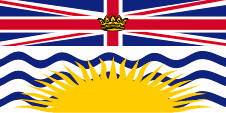
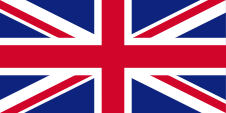
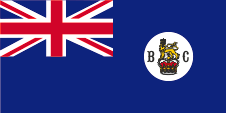
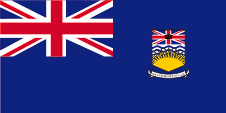
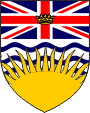
The flag of British Columbia was adopet on 27th of June in 1960. It is a scutcheon flag, because it shows the design of the coat of arms of the province. The flag may be used by provincial authorities and departments and also by private individuals. Until the year 1922 there had officially been used, the British Union Jack, the so-called Royal Union Flag, by the departments of the provinces, or (from 1922 nearly only) the Canadian blue official flag, the typical British Blue Ensign, with the coat of arms of Canada in the flying end. Nevertheless, the provincial authorities had their own seals and later also coats of arms, which were unauthorized placed in the flying end of the blue official flag. A permit should have been approved by the British authorities for this procedure, this was not the case, but was tolerated. Private individuals had to use the Union Jack and from 1892 the so-called Red Ensign, the red version of the Canadian flag with the Union Jack in the upper corner and the coat of arms of Canada in the flying end. In the course of the gradual separation of Canada from the United Kingdom the Blue Ensign as an official British flag lost its meaning and became replaced by new provincial flags, which may be used by authorities and departments of the provinces and also by private individuals. In this way, British Columbia introduced the current flag in 1960. The flag of the province follows British specifications due to history. They are: Blue = Pantone 280, Red = Pantone 186, Yellow = Pantone 116.
There is a regular coat of arms for British Columbia, with a console, shield holders (supporters), withe a crest and the motto. Here is only depicted the central part of the coat of arms, the escutcheon. The escutcheon of British Columbia shows in the upper part the British Union Jack and in the lower part the sun and ocean's waves. They remember the situation of British Columbia on the coast of the Pacific Ocean, and the over the Pacific sinking sun.
31st of March in 1778 · Captain James Cook lands in Nootka Sound and claims Vancouver Island for the United Kingdom
1794 · Spain renounces its claims to Vancouver Island and the surrounding islands
1827 · Fort Langley is founded as a British trading post
1843 · the Hudson's Bay Company (HBC) establishes Fort Camosun, the first permanent settlement, which later becomes the city of Victoria
1846 · border treaty with Oregon, establishing the southern border at the 49th parallel, beginning of settlement in what is now British Columbia
1849 · the HBC moves its regional headquarters from Fort Vancouver (now Portland, USA) to Victoria; the Canadian mainland opposite the city is known at this time as New Caledonia
13st of January in 1849 · United Kingdom forms Vancouver Island into a crown colony, with Victoria as its capital from 1851, but leases it to the HBC for 10 years
1855 · establishment of a colonial council, gradual curbing of the HBC's omnipotence
1858 · Fraser Canyon Gold Rush, thousands of settlers flock to mainland New Caledonia, administered by the HBC
2nd of August 1858 · United Kingdom declares mainland New Caledonia to the Colony of British Columbia, with Fort Langley as its capital
1863 · Arthur Edward Kennedy becomes governor of the colony of Vancouver Island and implements reforms
6th of August in 1866 · The colonies of British Columbia and Vancouver Island are merged to form the United Colony of Vancouver Island and British Columbia, with Victoria as its capital
1871 · the United Colony of Vancouver Island and British Columbia joins the Canadian Confederation
The name British Columbia comes from the Columbia River, a 1.953-kilometre-long river that today flows through Canada and the United States. The river is named after the ship "Columbia Rediviva", which sailed up the Columbia River under the command of American captain Robert Gray on 11 May 1792.