zur deutschen Version, Flagge klicken oder tippen

- historical region in today's France
- former county, nominal duchy and province
• Flag
• Meaning/Origin of the Flag
• Coat of Arms
• Meaning/Origin of the Coat of Arms
• Map of the historical Regions in France
• Explanations about the Regions
• History
• Origin of the Country's Name
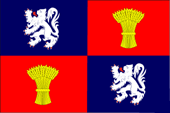
Flag of Gascony,
Source, by: Wikipedia (DE)


The flag of Gascony is a scutcheon-flag, its design is the image of that coat of arms, which has been created in 1696 by King Louis XIV. for the Gascony. In modern France, there is no place for Gascony. The country was divided after 1789 into two departments, Landes and Gers, which from 1960 were divided between two different regions. Landes came to Aquitaine, Gers to Midi-Pyrénées.
Source:
Volker Preuß
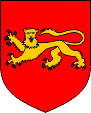
1032–1152,
Coat of arms of Aquitaine
– Blason du Aquitaine,
Source, by:
Wikipedia (DE)
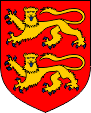
1194–1259,
Coat of arms of the Plantagenets
– Blason des Plantagenets,
Source, by:
Wikipedia (DE)
1259–1453,
Coat of arms of Guyenne
– Blason du Guyenne,
Source, by:
heraldique.org
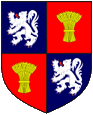
1696,
Coat of arms of Gascony
– Blason du Gascogne,
Source, by:
heraldique.org
The coat of arms, today known as the coat of arms of Gascony, is of recent origin. The crest is squared - four times divided - and the first and third field showed a silvery lion on blue, and the second and fourth field a golden sheaf of corn on red. It was created in 1696 by the French King Louis XIV., to expand heraldic visible, his personal, large coat of arms by the Gascony. The Gascony never had its own coat of arms, and the heraldry of the country was the heraldry of the rulers. So between 1032 and 1152, as the country was merged with Aquitaine in personal union, also between 1152 and 1259, when it belonged to the House of Plantagenet, and between 1259 and 1453 as Gascony belonged to the Duchy of Guyenne. The Guyenne used the same coat of arms as Aquitaine. About the meaning of the by King Louis XIV. created heraldry is nothing or not much known. Supposedly the lion should remember the County of Armagnac, but the colors do not match, and the quartering of the arms should be an indication that Gascony is a border province.
Source:
Heraldique Europeenne,
Volker Preuß
The historical, French Regions:

in black: governorate and province in 1776,
in red: former county, province oder governorate
Map: Volker Preuß
The provinces (or governorates) that existed until the French Revolution were historically grown entities that had often developed from former fiefdoms of the French crown, historical counties and duchies, often existed for hundreds of years and had preserved regional characteristics (cultural peculiarities and regional languages). Such phenomena were naturally undesirable to the French Revolution, and in the context of its bloody and violent egalitarianism, all regional references were eradicated. Shortly after the Revolution, the provinces were dissolved and France was divided into many small départements, which were to be approximately the same size and have the same status, controlled by prefects of the central administration in Paris. The departments were named after rivers or mountains so as not to use the names of any of the old provinces. However, it was not possible to sever the ties between the inhabitants of France and their respective historically grown regions, so that in 1960 regions were created again. There can hardly be said to be any real autonomy. The regions are only supposed to promote the economic, social, health, cultural and scientific development of the region, keep an eye on housing and living conditions, and provide support in some areas, e.g. urban development policy, urban regeneration, regional planning, preservation of regional identity and promotion of regional languages. When the regions were formed, departments located in a particular historical province were administratively grouped together into a region that often had the same historical name. The resulting entities only roughly corresponded to the boundaries of historical provinces. In strictly centralised France, however, any form of responsible regionalism is avoided. The regions do not even have their own seals with which to mark their own legally binding decisions, because there are no plans to introduce such a thing. Therefore, anything to do with coats of arms or flags is completely irrelevant. The logos of the regions are used generally, sometimes with the colours reversed and placed arbitrarily on flags or banners. There are no rules, as they are not official symbols. The logos and flags of the regions therefore often look like company logos: Unloving, unhistorical, technocratic and modernistic. That is why most of these regions have a kind of unofficial heraldic flag, which is intended to recall historical heraldic models. However, these are merely decorative in nature and are not a symbol of sovereign functions. The regions created in 1960 were even called into question in 2014, and a territorial reform was decided – centrally from Paris – which reduced the number of regions by almost half through mergers. The regions and their institutions were not even consulted on this matter.
Wikipedia Link to the regions of France:
click or tap here
FOTW Link to the regions of France:
click or tap here
Source: Flags of the World,
Wikipedia (D),
Volker Preuß
antiquity · colonization by Iberian and Celtic tribes, the largest of them are the Ausci, Boii and Vasates
52 B.C. · Roman conquest, forming the province of Aquitania in the west of Gaul
418 A.D. · the Visigoths be settled as federates, Aquitaine belongs to their sphere of influence
5th century A.D. · conquest of Gaul by the Franks (under King Clovis) to 507 conquest of Aquitaine, expansion of the empire to the Atlantic Ocean, the Pyrenees and the Alps
6th century · the Basques (Vascons) expand their influence in the northern Foothills of the Pyrenees and immigrate, they establish their Duchy of Vasconia (" Gascony ") in southern Aquitaine
511 · death of King Clovis, division of the Frankish Empire by Salic law of succession among his four sons (residences in Paris, Soissons, Orléans, Reims)
550 · administrative division of the empire into the kingdoms of Austrasia and Neustria, and the Duchy of Aquitaine and the Kingdom of Burgundy
581 · Frankish dukes rule over the Duchy of Gascony
603 · The Basques confirm the supremacy of the Frankish Merovingian Kings, but in the following years there are Basque uprisings against the Franks, they become military dejected in 635
635 · the Basques confirm the supremacy of the Frankish Merovingian Kings
639 · death of King Dagobert I., the power goes over to the Mayors of the Palace (maior domus) of Austrasia (House of the Carolingians)
660 · Gascony is incorporated into the Duchy of Aquitaine
687 · Pepin II. asserts itself as Mayor of the Palace throughout the Frankish Empire
8th century · the Moors (Islamic Arabs from North Africa) extend their influence over the northern Foothills of the Pyrenees, 769–812 follow Basque uprisings against the Franks, in this way comes the independence of the Gascony from the Duchy of Aquitaine from 812 to 819
732 · Battle of Tours and Poitiers, Charles Martel defeats the Moors, they are pushed back over the Pyrenees, in the following years, however, fights between the Dukes and the Frankish kings
751 · Pepin the Short (III., grandson of Pepin II.) eliminates the Merovingian monarchy and let hisself elect to the king from the Franks
771 · Charlemagne takes over Aquitaine and transmits it later as a kingdom to his youngest son Louis the Pious
814 · Louis the Pious hands over Aquitaine (and the Spanish March) to his son Pippin
817 · Pepin is king of Aquitaine, a few years later Louis the Pious transfers Aquitaine to his youngest son, Charles (Charles the Bald), who has difficulties to prevail as king in Aquitaine
819 · King Pepin I. of Aquitaine appoints Aznar Sanche to the Count of Gascony
843 · division of the Frankish Empire (Treaty of Verdun), there arise the West Frankish Kingdom of Charles II. (the Bald), the Middle Frankish Kingdom of Lothar (Lotharingia), and the East Frankish Kingdom of Louis II., Aquitaine comes to the Empire of Charles the Bald, However, there is resistance among the nobility, they prefer Pepin II. (son of ex-King Pepin)
845 · Charles the Bald sets Pepin II. as king in Aquitaine, but without Poitou, Saintonge and Angoumois
848 · Count Sanche Mitarrat calls himself a Duke
849 · election of Charles the Bald as King of Aquitaine
855 · Charles the Bald lets elect his son Charles to the King of Aquitaine
867 · Death of King Charles, he is succeeded by his brother Louis (Louis the Stammerer)
870 · at the division of the Frankish Empire (Treaty of Meersen) arises the West Frankish Kingdom, the East Frankish Kingdom, and the Frankish Kingdom of Italy
877 · Ludwig ascends the West Frankish throne, Aquitaine is given as a fief and a duchy to Rainulf, Count of Poitiers, (House of the Ramnulfids)
880 · by the division of the Frankish Empire (Treaties of Verdun and Ribbemont) arises the West Frankish Kingdom (later France), the East Frankish Kingdom (later German Empire), the Kingdom of Italy, the Kingdom of Upper Burgundy (under Rudolf the Welf) and the Kingdom of Lower Burgundy persists
898 · Odo, Count of Paris and Duke of Francia, is elected to the king of the East Frankish Empire, Rainulf takes over the title of the King of Aquitaine
10th century · the Duchy of Gascony reaches under Duke Garcia Sanchez le Tors (the crooked) its greatest extention, as far to the Garonne River, in the north to Bordeaux (it becomes the residence), but in the south get lost possessions as Navarre and Aragon, and some counties and vice-counties achieve more independence from Gascony
909 · Aquitaine is a duchy again, under William the Pious (Williamids, Gellones)
927 · Aquitaine comes to the House of Poitou (Ramnulfids)
950 · Aquitaine includes now the counties of Gascony, Armagnac, Fézensac, Périgord, Poitou, Angoulême and La Marche
1032 · After the extinction of the old Dukes of Gascony inherits Odo of Aquitaine the County of Gascony, Aquitaine and Gascony are thus united in a personal union
1152 · Henry Plantagenet marries Duchess Eleanor of Aquitaine, the duchies of Aquitaine and Gascony come to the house of Anjou-Plantagenet
1154 · death of Stephen of Blois (King of England) , Henry is his successor as Henry II., Anjou becomes in this way a fief of the French king, which is a part of the crown of England (House of Anjou-Plantagenet)
1204 · Philip Augustus, King of France, conquers Normandy, Anjou, Maine and Touraine (Angevin Empire of the Plantagenets)
1224 · King Louis VIII. of France, son of Philip Augustus, conquers Aquitaine, except Gascony the last possession of the Plantagenets in France, Poitou and Saintonge come directly to the crown, La Marche, Périgord, Angoulême and Auvergne become fiefs
1259 · Treaty of Paris (Abbeville), King Henry III. of England recognizes the loss of Aquitaine, and receives in this way the Saintonge, which is united with Gascony to the Duchy of Guyenne, as fief
1328 · death of King Charles IV. (the Fair), extinction of the direct Capetian line, according to Salic Law Count Philip of Valois (Son of Prince Charles of Valois, first cousin of King Charles IV.) came on the French throne (as King Philip VI .), the English king Edward III. lays claim to the throne as a maternal nephew of Charles IV., reason for the "Hundred Years War" (Anglo-French War, 1338–1453), out of the House of Valois came all kings of France from 1328 to 1589
1453 · Battle of Castillon, the end of the Hundred Years War, the Kings of England have to cede all their possessions in France, in this way the Guyenne comes finally to France, the country is connected to the royal domain, later establish of the governorate (province) of Aquitaine, to which the Guyenne belongs as a province
1589 · death of Henry III., King of France, Henry III. had no descendants, extinction of the line of Valois, Henry III. determined Henry of Navarre (House of Bourbon) as his successor, which is as Henry IV., the Good, Henri le Bon, the new King of France
1776 · the already in the 14th century created governorates of the civil administration of the kingdom of France become committed to a number of 39, and correspond in this way to the number of provinces, in previous years could any provinces be summarized in one governorate
1789 · French Revolution, the governorates and provinces become abolished, Aquitaine is divided into departments (approximately: Gironde, Dordogne, Lot, Aveyron, Landes, Lot-et-Garonne, Gers, Hautes-Pyrenees and Haute-Garonne)
1960 · reintroduction of regions in France, the Gascony doesn't play a role, affiliation with the newly created Aquitaine region (capital Bordeaux), of course not within the historic boundaries, just by integrating of the departments of Dordogne, Gironde, Landes, Lot-et-Garonne and Pyrénées-Atlantiques
2016 · the Aquitaine region merges with the Poitou-Charentes and Limousin regions in the new, larger region of New Aquitaine (Nouvelle-Aquitaine)
Source:
Wikipedia (D),
Meyers Konversationslexikon
The name "Gascony" goes back to the Basques, who have immigrated in the 6th century in the northern Pyrenees foothills. They were then called "Vascons" and founded here their Duchy of Vasconia. This geographical term became over the times to "Gascony".
Source:
Volker Preuß,
Meyers Konversationslexikon