zur deutschen Version, Flagge klicken oder tippen

- historical region in France
- former county and duchy
• Flag
• Meaning/Origin of the Flag
• Coat of Arms
• Meaning/Origin of the Coat of Arms
• Map of the historical Regions in France
• Explanations about the Regions
• History
• Origin of the Country's Name
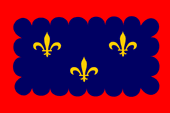
Flag of Berry – Drapeau de Berry,
Source, by:
Die Welt der Flaggen


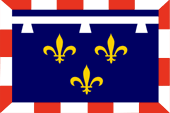
1960–2016,
Unofficial flag of the Centre Region
– drapeau officieux de la région Centre,
Source, by:
Wikipedia (D)


The flag of Berry is a scutcheon-flag, its design is the image of the coat of arms. In the year 1360 King John II. of France raised the Berry to a duchy and passes it to his son John. The belonging Heraldry showed the blue, with golden lilies topped shield of the Capetians, which was surrounded by a red border with a scale-cut. The from 1960 to 2016 existing Region of "Centre" used an unofficial flag, which combines the features of the flags of Orléanais, Berry and of the Touraine.
Source:
Volker Preuß,
Wikipedia (D)
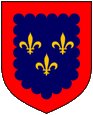
Coat of arms of Berry
– Blason de Berry,
Source, by:
Wikipedia (DE)
In the year 1360 King John II. of France raised the Berry to a duchy and passes it to his son John. The belonging Heraldry showed the blue, with golden lilies topped shield of the Capetians, which was surrounded by a red border with a scale-cut. The coat of arms of the Capetians showed three golden lilies on blue, but originally was the coat of arms sprinkled with lilies. From 1365 (by others sources 1376), the number of lilies was reduced to three. The lily-symbol is very old, already the Germanic tribe of the Franks has used it. The House of the Capetians has provided the kings of France between 987 and 1328. It goes back to Hugo Capet, son of Hugo the Great, who was electet to the King of France, in 987, after the death of King Ludwig V. from the House of the Carolingians. The Capetians brought out three branch lines which became the Kings of France: Valois 1328–1589, Bourbon 1589–1792 and 1814–1830, and Orléans 1830–1848.
Source:
Wikipedia (D),
Volker Preuß
The historical, French Regions:

in black: governorate and province in 1776,
in red: former county, province oder governorate
Map: Volker Preuß
The provinces (or governorates) that existed until the French Revolution were historically grown entities that had often developed from former fiefdoms of the French crown, historical counties and duchies, often existed for hundreds of years and had preserved regional characteristics (cultural peculiarities and regional languages). Such phenomena were naturally undesirable to the French Revolution, and in the context of its bloody and violent egalitarianism, all regional references were eradicated. Shortly after the Revolution, the provinces were dissolved and France was divided into many small départements, which were to be approximately the same size and have the same status, controlled by prefects of the central administration in Paris. The departments were named after rivers or mountains so as not to use the names of any of the old provinces. However, it was not possible to sever the ties between the inhabitants of France and their respective historically grown regions, so that in 1960 regions were created again. There can hardly be said to be any real autonomy. The regions are only supposed to promote the economic, social, health, cultural and scientific development of the region, keep an eye on housing and living conditions, and provide support in some areas, e.g. urban development policy, urban regeneration, regional planning, preservation of regional identity and promotion of regional languages. When the regions were formed, departments located in a particular historical province were administratively grouped together into a region that often had the same historical name. The resulting entities only roughly corresponded to the boundaries of historical provinces. In strictly centralised France, however, any form of responsible regionalism is avoided. The regions do not even have their own seals with which to mark their own legally binding decisions, because there are no plans to introduce such a thing. Therefore, anything to do with coats of arms or flags is completely irrelevant. The logos of the regions are used generally, sometimes with the colours reversed and placed arbitrarily on flags or banners. There are no rules, as they are not official symbols. The logos and flags of the regions therefore often look like company logos: Unloving, unhistorical, technocratic and modernistic. That is why most of these regions have a kind of unofficial heraldic flag, which is intended to recall historical heraldic models. However, these are merely decorative in nature and are not a symbol of sovereign functions. The regions created in 1960 were even called into question in 2014, and a territorial reform was decided – centrally from Paris – which reduced the number of regions by almost half through mergers. The regions and their institutions were not even consulted on this matter.
Wikipedia Link to the regions of France:
click or tap here
FOTW Link to the regions of France:
click or tap here
Source: Flags of the World,
Wikipedia (D),
Volker Preuß
antiquity · settlement by the Celtic tribe of the Bituriges, from there the other name of the country: "Biturica"
52 B.C. · Roman conquest, to the province of Gallia Lugdunensis
5th century A.D. · today's Berry belongs to the kingdom of the Visigoths, from 480 conquest of Gaul by the Franks, until 507 (under King Clovis) expansion of the empire to the Atlantic, the Pyrenees and the Alps, the area of today's Berry comes to the Frankish Empire, namely as a part of Aquitaine
880 · at the division of the Frankish Empire (Treaty of Verdun and Ribbemont) was created the West Frankish Kingdom – the later France – to which the today's Berry belongs as County of Bourges
917–1100 · Bourges is governed by viscounts of the Dukes of Aquitaine, the last viscount, Eudo Arpie, sells the county to King Philip I. of France
1101–1221 · the County of Bourges gats at first divided into Lower Berry and Upper Berry and then gradually connected to adjacent counties or duchies (Aquitaine, Anjou, Blois and Bourbonnais), in this way Berry becomes a part of the royal domain
1360 · Berry gets revived by King John II. of France (House of Valois) , raised to a duchy, and given as an appanage to his son John
1419–1461 · Charles of France, son of Charles VI . King of France, is Duke of Berry, after the accession to the throne even as King Charles VII. (1422–1461)
1461–1465 · Charles, the youngest son of King Charles VII., is Duke of Berry
1498–1549 · the duchy is handed over by the king in different ways, so to Joan of France, Claude of France and Margaret of Angoulême
16th to 18th century · the Duchy of Berry is no longer given as an appanage, it becomes a province, only the title remains as one out of the many titles of the French monarchy
1776 · the already in the 14th century created governorates of the civil administration of the kingdom of France become committed to a number of 39, and correspond in this way to the number of provinces, in previous years could any provinces be summarized in one governorate
1789 · French Revolution, the governorates (provinces) become abolished, Berry is divided into departments (essentially Cher and Indre and small parts of Creuse, Vienne and Loiret)
1960 · reintroduction of regions in France, formation of the Centre region with Orléans as capital, Berry doesn't play a role, affiliation with the newly created Centre-Val-de-Loire region, of course not within the historic boundaries, just by integrating of the departments of Cher, Eure-et-Loir, Indre, Indre-et-Loire, Loir-et-Cher and Loiret, the department of Vienne comes to the region of Poitou-Charentes
Source:
Wikipedia (D),
Meyers Konversationslexikon
"Berry is a landscape in central France. Its name comes from the Gallic tribe of Bituriges, its inhabitants are called Berrichons. ..."
Quote: Wikipedia (D), status 03-2014